

Recently, Meta demonstrated an AR glasses called “Orion”, which can superimpose images in different depths and sizes while maintaining the natural vision of the real world, and the holographic image displayed on its transparent lens provides users with a brand-new visual experience and enhances the perception of and interaction with the real world.
Nowadays, AR technology is gradually becoming a key force to change people's daily life and work style, AR glasses are gradually from the concept to reality, is expected to usher in the explosive growth in the next few years.
AR glasses is actually a specific application of optoelectronics technology, along with the development of intelligent driving, cloud computing, optoelectronics technology will be increasingly used in 3D vision, vehicle radar and many other fields, to promote the perception of upgrading and next-generation interaction revolution.
Around the optoelectronics technology and industry, Wenxin interviewed Dr. Tao Lin, Chairman of North Ocean Photonics (hereinafter referred to as “NOP”), in which he shared and interpreted the company's business layout, technological progress, research and development of products, as well as the development of the current status of the optoelectronics industry, the future trend of the industry and other dimensions.

mage | Dr. Lin Tao, Chairman of Kunyou Optoelectronics (Source: Interviewee)
Tao Lin received his undergraduate degree from Zhu Kezhen College in the Department of Optoelectronics of Zhejiang University and received his Ph.D. in Optoelectronics from the University of Cambridge as an Intel Scholar, during which he published more than 20 IEEE/IEE papers in the field of optoelectronics. During his doctoral studies, he published more than 20 IEEE/IEE papers in the field of optoelectronics, and after graduating from the doctoral program in 2006, Lin Tao worked successively as a derivatives trader at Barclays Capital, an Associate Global Managing Partner at McKinsey & Company, and a Partner at Fosun Kunzhong Capital.
“From academia, to finance, I have gained some experience in various aspects of strategy, consulting, operations, and M&A financing.” He describes, “Based on my insights into market trends and predictions of future technology development, I decided to return to the field of optoelectronics and start my own business.”
At the end of 2016, North Ocean Photonics was founded, specializing in the field of optoelectronics technology, especially the development and application of “wafer-level optics”.
Talking about the original intention of founding NOP, Lin Tao summarized two points: “First, I come from the field of optoelectronics technology, and my research direction from undergraduate to doctoral degree centers around the field of optoelectronics; second, based on the previous experience of domestic and abroad and in different fields, we can see some probable trends in the future development of the market of optoelectronics.”
“The establishment of North Ocean Photonics is, to a large extent, an optimal solution that we seek based on the overall market prediction and industry development, and it is a process of water falling into place.” Lin Tao pointed out, “We were the first to see the market demand, as well as the development trend of both domestic and abroad, even including the shareholders and customers more clear intention, combined with the team's own academic background, industrial background and the background of the capital side, according to this claim to form the company, to ensure that the whole company can be targeted. At the beginning of the team's formation, we already have a clearer idea of business landing.” He added.
Developing Optical Components with a Wafer Mindset.
For a long time, the optical industry is mostly based on “cold optical processing technology”, such as lenses manufactured through grinding, injection molding, etc., this production process has a history of hundreds of years.
“To the optical’s 'twin' electronics, for example, the IC industry in recent decades has developed extremely rapidly, has achieved a high degree of integration, miniaturization. In contrast, most current optical processes rely on traditional cold optical processes, and the limitations of such processes are obvious, especially in terms of precision and scale.” Lin Tao pointed out.
“About ten years ago, the industry started to use wafers to develop optical technology. In fact, the concept of developing optics on wafers existed a long time ago. Wafer-level optics can be considered a major innovation that upgrades the traditional production processes that have been used in optics for hundreds of years. However, this technology remained in academic circles for a long time, with no opportunity for industrialization, and it was not until 2015 that it took a turn for the better.” He describes.
At that time, two products appeared on the market, the Microsoft HoloLens and the Apple iPhone X. “On the technical level, both products used diffractive optical components and technology, which is fundamentally different from the previous 'grinding and polishing' cold optical process. The launch of these two products is an important revelation for NOP: Firstly, optics can be done on wafers like ICs with the idea of lithography; Secondly, the time to enter the consumer market may have come.” He said.
“Previously, there hasn't been such an opportunity, but both of these products are consumer electronics, consumer-oriented products that can be mass-produced, and the development of wafer-level optics can draw on a lot of the technology used in semiconductor integrated circuits.” He added.
(Source: Interviewee)
Currently, North Ocean Photonics has a team of nearly 300 people. “We specialize in developing optical components using the wafer mindset, and we are in IDM mode, from design, to production, to mass production and quality control, all these processes form a complete closed loop within the company.” Lin Tao said.
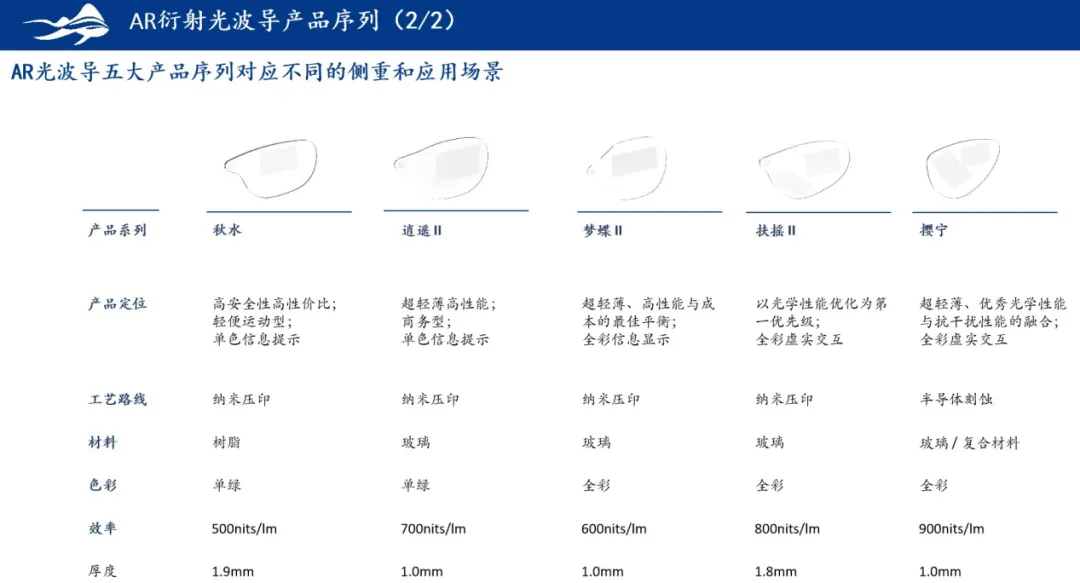
North Ocean Photonics has built a wafer-level optical platform, around the platform layout of three types of product lines. First, micro-nano optics, such as structured light sensors in cell phones, 3D TOF imaging and other components; second, AR diffractive optical waveguide, which is the display part of the meta-universe; and third, LIDAR, which includes fiber optic arrays, fiber optic modules and so on.
Regarding the milestones the company has achieved since its inception, Lin Tao said, “It can be divided into two aspects, on the one hand, internal team building, and on the other hand, product innovation and research and development.”
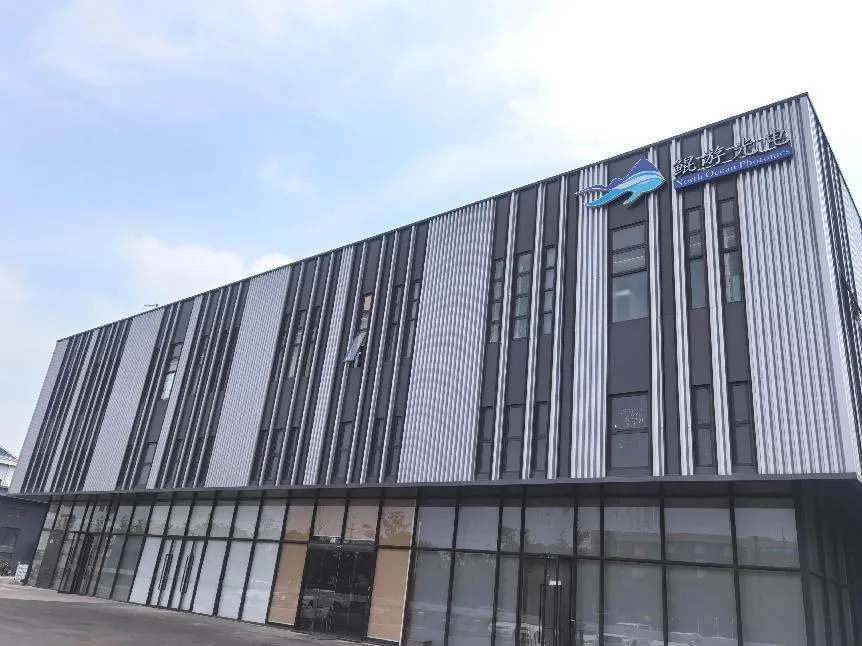
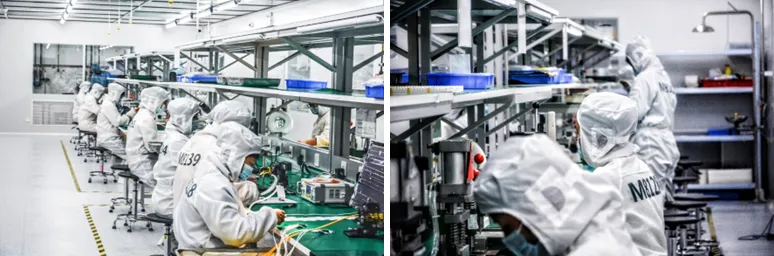
In terms of internal construction, “Since its establishment nearly 8 years ago, the team size has been maintaining a steady expansion. At present, we have a R&D and production base of about 10,000 square meters, including 100-level ultra-clean room, 1,000-level ultra-clean room, etc., and complete facilities for design, lithography, etching, etc., so that we can be self-sufficient from the foremost design to the later mass production, as well as the production of photomasks and processing of masters; in terms of intellectual property rights, we have already obtained more than a hundred patents for our technology, and in addition to the domestic patents, we also focus on PCT patents, U.S. patents, etc., which are the most important patents in China. In addition to domestic patents, we also pay more attention to PCT patents, U.S. patents, etc., forming a complete patent closed loop.” He introduced.
At the certification level, North Ocean Photonics has ISO certification and IATF16949 certification. “We are also one of the few companies in the industry that have the certification of QC supply from automobile manufacturers.” He pointed out.
In terms of product development, “From 2019, the micro optics series products we developed began to be supplied to Huawei, one of its few suppliers of this product type.” Lin Tao introduced.
“For AR products, in fact, we have developed full-color diffractive optical waveguides at the beginning of our establishment, which belongs to a very early stage in China, however, due to the fact that the market demand did not form a scale at that time, so it stayed at the small batch level for a long time. Until the past two years, with the strong market demand, AR product line began to volume.” He said, “For LiDAR, we started supplying NIO two years ago. Most of the LiDAR core components (fiber module master) in NIO cars are from North Ocean Photonics.”
“In recent years, the penetration rate of the company's three major product lines under the wafer-level optics platform has been steadily increasing. the 3D and micro optics product lines have steadily shipped to tens of millions of pcs; the LIDAR products have shipped hundreds of thousands of sets; and since last year, the AR diffractive optical waveguide products have also begun to grow at a high rate, with more than 100,000 sets last year, and it is expected that they can reach 200,000 sets this year.” He added.
With a complete closed loop, production is self-sufficient.
Along with Moore's law towards the limit, semiconductor process technology is facing great challenges, electronic devices reach the nanometer scale when the tunneling effect, it is difficult to enhance the performance by reducing the size of the device and improving the degree of integration. “The development of the IC industry can be said to have reached the red sea stage, and its threshold is getting higher and higher, from 14nm, to 7nm, to 3nm, 2nm, basically the international giants of the 'arena', and the investment is extremely huge, and the marginal return is not high.” Lin Tao said.
“Compared with the IC industry, the optoelectronics industry is still relatively preliminary, and the development of the next few years is a very good opportunity. It is relatively new, both in terms of inputs and technology, which means that the space for its development is huge.” He pointed out that “in the past two years, many innovative consumer electronics, such as AR glasses and LIDAR, are related to new optical technologies. Judging with these emerging products and new demands, I think the optoelectronics industry is a very good direction.” He adds.
“For the positioning of North Ocean Photonics, we have not focused on being a company that develops a specific product, we focus on 'wafer-level optics' and hope to be the pioneer of wafer-level optics in China to kick off 'consumer photonics' .” He pointed out that “the essence of wafer-level optics is to use the wafer mindset to develop optical components, which is in fact a generalized technology platform that is not limited to a particular product. Based on wafer-level optics technology platform, can develop a variety of products, and different products can be combined, according to the market is in the peaks and valleys to hedge each other. In contrast, a single product would be more risky.” He explained.
Talking about the challenges faced by the company, “Wafer-level optics itself belongs to the emerging things, compared with the traditional cold optics is a completely revolutionized thing, and this needs to face the uncertainty of the market.” Lin Tao said.
“The same goes for product development. The products we launched, whether it is 3D imaging, or AR/XR, or LiDAR, are not stock product categories, they are all emerging products in the last two years, and since they are emerging products, they are bound to face market fluctuations.” He pointed out that “although we are a high-tech enterprise, but essentially still belongs to the category of manufacturing, thus need to obey the laws of market development. Manufacturing input research and development cycle is relatively long, and the market is constantly fluctuating. Therefore, the biggest risk is market risk.”
“Based on this, we will need to focus on risk prevention in the future, for example, to ensure a good existing stock of business, future R & D investment, the uncertainty of the market, as well as different product lines in relation to each other, these are the places we focus on.” Lin Tao said.
Compared to international peer companies, Lin Tao believes that North Ocean Photonics' greatest competitiveness is to have a complete closed loop. “We have a layout first, and then expand step by step, it is a breakthrough by surface rather than point. The company was founded with a systematic, complete, closed-loop (IDM mode) idea for product development, with complete production facilities, functional teams, and the ability to realize self-sufficiency, basically no short board.” He noted.
“In addition, our shareholders includes industrial investment organizations, financial institutions, as well as the support of local governments, including Shanghai Lingang Science and Technology Venture Capital, Shanghai Pudong Science and Technology Venture Capital, and Yuanhe Holdings.” He added.
Talking about the future market competition in the optoelectronics industry, in Lin Tao's view, competitors can be roughly divided into three categories. The first category, international giants, such as Microsoft, Meta, Apple and so on. “Since the optical piece requires a high degree of customization and is a core technology, this type of international giants will tend to independently and autonomously control R&D and production.” He pointed out.
The second category, the traditional large optical component manufacturing enterprises. “Europe, the United States and China have a number of relatively large companies, as well as traditional optical enterprises, also see the prospects of wafer-level optics, will join the market competition.” He said.
The third category, start-up companies. “This type of company sees the potential of wafer-level optics technology and the future development of the optoelectronics industry, so it focuses on specialization. We are in this category.” He said.
Regarding the competitive landscape, Lin Tao said, “International giants prefer to develop on their own, but may outsource some of their products to startups or large optical manufacturing companies for cost considerations. Overall, the three types of competitors will coexist for a long time, but the products developed will be compartmentalized for different market segments.” He said.
“In our own case, the IDM mode has the advantage of being more flexible and targeting a wider customer base. We will be more customized, for example, some customers will deliver the whole product to us, from start to finish by ourselves, so the audience customer base will be broader.” Lin Tao concluded.
